3rd SIBECOL Meeting and XVII Nacional AEET conference, Pontevedra 2025
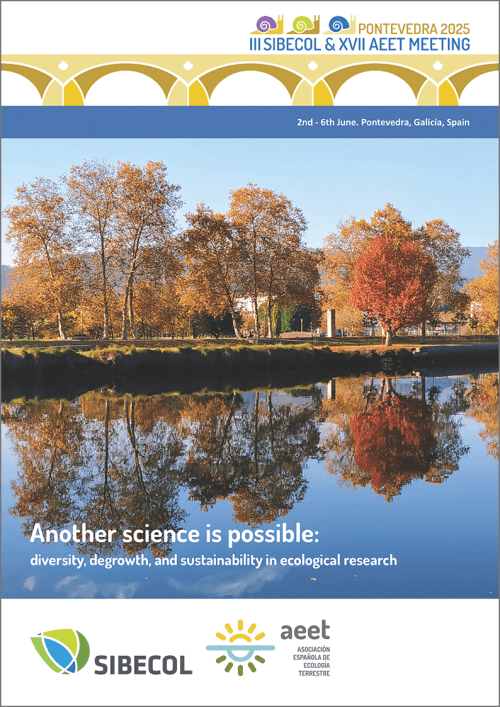
The III meeting of the Iberian Ecological Society (SIBECOL) was held jointly with the XVII National Conference of the Spanish Association of Terrestrial Ecology (AEET) in June 2025. 888 people participated in this event. Many of the attendees were early-career researchers who had the opportunity to present their work, network with colleagues, and build professional connections that will be invaluable to their scientific careers.
The conference took place in Pontevedra from June 2nd to 6th, 2025. Pontevedra is a city known for its commitment to urban pedestrianization and has received various awards for its sustainable mobility policies. Leveraging the unique location, the conference adopted a theme that encourages reflection on our profession and the tasks ahead to improve our daily practices: "Another science is possible: diversity, degrowth, and sustainability in ecological research". This theme underscores the importance of fostering a diverse scientific community and adopting sustainable practices within ecological research. It invited participants to explore how ecological science can evolve by embracing principles of diversity and sustainability. The conference aimed to inspire discussions and collaborations that drived positive change in the field of ecology, promoting a more inclusive and sustainable future for scientific research.
Scientific Sessions
The general sessions addressed were:
♦ Enhancing Inclusivity, Ethics, and Societal Impact in Science;
♦ The Ecology Across Scales;
♦ The Interplay Between Species Coexistence and Abiotic Factors: Community Ecology;
♦ Ecology Meets Evolution;
♦ Are We at a Global Tipping Point? Biodiversity Conservation and Ecosystem Services Sustainability and
♦ New Technologies, New Discoveries: Big Data, Remote Sensing, and AI.
Furhermore a total of 43 Thematic Sessions were scheduled within this 6 General Sessions, covering a wide range of specific topics relevant to ecological research.
Plenary talks
Thirteen plenary presentations were given by renowned and promising researchers, addressing a diverse array of innovative issues.
- Silvia Castro, Assistant Professor at the Department of Life Sciences and Centre for Functional Ecology, University of Coimbra (UC).
- Iván Gómez-Mestre, Researcher of the Ecology, Evolution and Development Group Estacion Biologica de Doñana (EBD-CSIC).
- Carlos M. Herrera Maliani, Emeritus Professor of Research at the Doñana Biological Station (EBD-CSIC).
- Rafael Marcé, Research Scientist at the Centre for Advanced Studies (CEAB-CSIC), Blanes, Spain.
- Silvia Matesanz, University Professor and Academic Secretary of the Global Change Research Institute (IICG), Rey Juan Carlos University (URJC).
- Beatriz Mouriño, Researcher at the Biological Oceanography group of the CIM-UVigo and Professor at the University of Vigo.
- Elena Ojea, Oportunius Research Professor at the Future Oceans Lab, CIM-University of Vigo (Spain).
- Sara Palacio, Tenured scientist at the Instituto Pirenaico de Ecología, Spanish Research Council (IPE-CSIC).
- Mario Pansera, Oportunius Research Professor affiliated to the University of Vigo and affiliated Researcher at the Autonoma University of Barcelona (UAB).
- Carlos Pérez Carmona, Professor of Functional Ecology, University of Tartu.
- Bernardo Quintella, Assistant Researcher at MARE – Marine and Environmental Sciences Centre, University of Lisbon, Faculty of Sciences.
- Christina Richards, Researcher at the University of South Florida & University of Tübingen.
- Andrea Sánchez Messeguer, Researcher at the Real Jardín Botánico (RJB-CSIC).
Complementary activities
New in this edition, 6 quick-fire talks (10 min) tackling cross-cutting themes linked to our conference motto were given. Furthermore there were held 10 workshops, dealing with specific knowledge or skills in the use of auxiliary technology tools in order to improve quantitative and qualitative research methods. They involved extended discussion as well as hands-on training sessions. 3 Technical field trips will be featured providing opportunities to showcase knowledge and applied technologies on ecological systems in real-world settings. Specific meetings for early career researchers were promoted to encourage social interaction during the conference and generate synergies in the scientific field. Plus, public participation activities were held, such as an exhibition of scientific illustrations, a micro-story contest inspired by the work of women scientists, visits by school students, and other outreach activities throughout the city.
Workshops
♦ Evidence Synthesis in Ecology
♦ Knowledge Transfer in Ecology: Barriers & Opportunities
♦ Promoting Creativity in Scientific Research
♦ Building a DIY BtM Datalogger for Moss & Lichen Water Monitoring
♦ Introduction to Structural Stability in Ecology
♦ Introduction to Bayesian Inference in Ecology (R & Nimble)
♦ Reproducible & Collaborative Research in R (GitHub & Quarto)
♦ Big Data & Remote Sensing for Biodiversity Monitoring
♦ How to Land Competitive Projects (and Survive the Process)
Field Trips
♦ Carreirón Natural Park and Illa de Arousa – Coastal Ecosystems and Birdlife in a Protected Marine Landscape
♦ Illa de Sálvora – Exploring a Wild Jewel of the Galician Atlantic Islands National Park
♦ Hiking in Serra do Cando–Suído – Atlantic Mountains, Highland Biodiversity, and Sacred Landscapes
Family conciliation
Aware of the importance of balancing family life with scientific activity and the difficulties that female scientists with young children face in attending conferences, the organizers will implement effective family reconciliation measures such as providing childcare services and a family room that tendees can use to rest with their families, and facilitating access to the facilities for caregivers.
Awards
As is customary at our conferences, awards were given for the best oral presentations and posters, as well as the institutional awards that the AEET grants every two years in recognition of the most significant contributions in our field of study: the scientific careers of researchers (Awarded to Adrián Escudero); contributions to the dissemination of knowledge (Awarded to Ximena Herrera-Álvarez); the promotion of diversity and inclusion of all types of groups in academia (Awarded to Mar Sobral); and the development of freely available tools and the promotion of transparent and reproducible practices in science (Awarded to the CECO-UAL center).
The conference in numbers
This meeting was attended by 888 participants. A total of 751 contributions were presented: 13 plenary talks, 474 oral standard talks and 264 posters, all collected in the book of abstracts of the meeting.
Download here the 3rd SIBECOL & XVII AEET meeting ABSTRACT BOOK
Download here the 3rd SIBECOL & XVII AEET Hand PROGRAM
Acknowledgements
We would like to thank all our scientific partners, the University of Vigo (UVigo), the University of Santiago de Compostela (USC) and the Biological Mission of Galicia (MBG-CSIC) for supporting this project formulated with the aim to provide a platform for the exchange of the latest knowledge on ecology and to inspire debates and collaborations that will drive positive change in the field of ecology, promoting a more inclusive and sustainable future for scientific research.